AI Citations vs. Clicks: Why Winning One Without the Other Isn't a Win
Last Updated On : August 19, 2026
Share this post

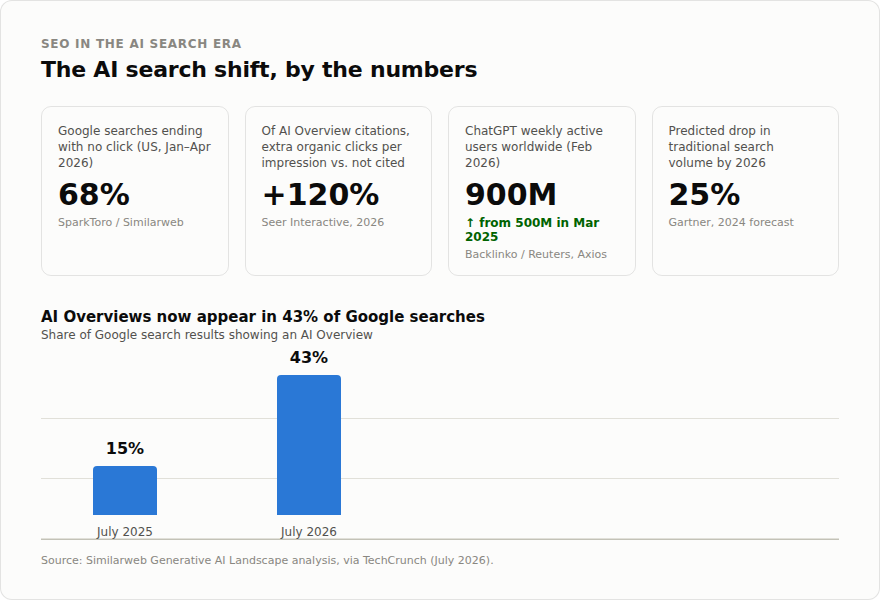
In the first four months of 2026, 68% of Google searches in the U.S. ended without a single click, according to research firm SparkToro's analysis of Similarweb clickstream data. Two out of every three times someone searches, they get their answer and leave. No visit, no session, no line item on your traffic report.
Read that number the wrong way, and it looks like a eulogy for search marketing. Read it correctly, and it's the opening argument for why the industry needs a new scoreboard.
SEO isn't dying. It's being measured differently, and in 2026, the platforms themselves began building tools to prove it.
Key Takeaways
- AI Overviews now appear in 43% of Google searches, up from 15% a year earlier, and 68% of U.S. Google searches end without a click
- An AI citation, being named as the source inside an AI-generated answer, is becoming a metric marketers need to track alongside the click, not instead of it
- Being cited inside an AI Overview drives 120% more organic clicks per impression than not being cited on the same query
- Google Search Console, Bing Webmaster Tools, and Ahrefs have all shipped dedicated AI citation reporting, on their own timelines, between March 2025 and June 2026
- A citation that fully answers the question inside the AI summary kills the click. The ones that convert create curiosity instead of closing it
The Scale of the Shift, in Numbers
For most of the past two decades, “did we rank” and “did they click” were close enough to the same question that nobody needed to separate them. That's no longer true, and the data shows how fast the gap opened.
Google's AI Overviews appeared in 43% of searches as of July 2026, up from just 15% a year earlier, according to Similarweb's Generative AI Landscape analysis. AI Mode, the fuller conversational layer inside Google Search, grew from 126 million visits in June 2025 to 279 million by May 2026, more than doubling in under a year.
It isn't only Google. ChatGPT now has more than 900 million weekly active users worldwide as of February 2026, up from 500 million just eleven months earlier, per data compiled by Backlinko from Reuters, Axios, and The Information. Roughly a third of U.S. adults have used it at least once.
Back in 2024, Gartner predicted traditional search engine volume would drop 25% by 2026 as generative AI tools became substitute answer engines. That exact number hasn't landed. Google still commands more than 90% of the search market, and later analysis argues the prediction got the direction right but the mechanism wrong: instead of losing ground to standalone chatbots, Google absorbed the shift by building AI answers directly into its own results. People didn't leave search. Search changed underneath them. That distinction matters because it means the click-volume conversation and the AI-visibility conversation are now the same conversation, just measured with different instruments.
Why the Click Stopped Telling the Whole Story
An AI citation is a mention of your brand, page, or data as the named source inside an AI-generated answer, on a platform like Google AI Overviews, AI Mode, Copilot, ChatGPT, or Perplexity, whether or not the person reading that answer ever clicks through.
Here's the mechanism worth sitting with: when an AI system answers a question directly, the content that informed that answer already did its job before anyone had the option to click. The value was captured at the time of the answer, not at the time of the visit.
That value appears uneven right now. Similarweb's July 2026 data found that only 6.8% of U.S. ChatGPT desktop queries included a citation as of May 2026, even though citation frequency has risen fivefold over the past year. That's a system still early in how consistently it attributes sources, moving fast toward more attribution, not less.
And when a citation does happen, it's worth more than the raw click math suggests. A 2026 study by Seer Interactive, tracking 53 brands across 5.47 million queries and 2.43 billion organic impressions from January 2025 through February 2026, found that being cited inside an AI Overview delivered 120% more organic clicks per impression than not being cited on the same query. Citation didn't fully replace the old best case (queries with no AI Overview at all still outperformed cited queries by about 38%), but it was consistently and measurably better than the alternative of appearing in the AI answer and being skipped entirely.
That's the real argument for treating citation as its own metric. It isn't just a consolation prize for lost clicks. It's a leading indicator of which clicks you still get. It's also, as it turns out, not the whole story either, more on that gap in a minute.
Google, Bing, & Ahrefs Just Made It Official
Here's what should end the “is this real” debate inside any marketing org. Over roughly a fourteen-month stretch, the two dominant search engines and the leading SEO tooling platform each shipped dedicated reporting on AI citation visibility, independently of one another.
Ahrefs moved first, launching Brand Radar in March 2025 to track brand mentions across ChatGPT, Perplexity, Copilot, Grok, AI Overviews, and AI Mode in a single dashboard.
Bing Webmaster Tools followed, previewing an AI Performance report with an AI Citation Share metric on April 27, 2026, then rolling it out more broadly on June 16, 2026, tracking how often a site is referenced in Copilot's AI-generated answers.
Google Search Console shipped its own Generative AI Performance report on June 3, 2026, breaking out impressions and clicks specifically from AI Overviews and AI Mode, separate from traditional search results.
When a search engine, a search engine's closest competitor, and the industry's leading SEO platform all decide independently, on three different timelines, that the same new metric deserves its own permanent dashboard, that's not three companies chasing a trend piece. That's three companies confirming, with product decisions, what already changed under the hood.
It's Not Just What You Write. It's Who's Writing About You
There's a layer to this that goes beyond how a piece is structured. Muck Rack's May 2026 "What Is AI Reading?" study, the third edition of an ongoing analysis of more than 25 million links cited by ChatGPT, Claude, and Gemini, found that earned media, independent journalism, third-party coverage, and editorial mentions account for 84% of all AI citations. Paid and advertorial content accounts for 0.3%.
That's not a rounding difference. It means the single biggest lever for AI citation isn't on-page at all. It's whether credible, independent outlets are writing about a brand in the first place. An AI system citing a source is, in effect, borrowing that source's credibility. Editorial coverage carries an implicit trust signal that a brand's own blog post doesn't, no matter how well that post is structured or how citation-worthy its claims are.
This changes the shape of the strategy. Structuring owned content to be quotable earns citation when an AI system already has a reason to look at that page. Earned coverage is what gets a brand into consideration at all. The two aren't competing tactics; they're sequential: earned coverage builds the trust an AI system is optimizing for, and citation-worthy on-page content is what gets pulled once that trust exists.
It also carries stakes beyond top-of-funnel visibility. 6sense's 2025 Buyer Experience Report, based on more than 4,000 B2B buyers, found that 94% of buying groups had already ranked a preferred vendor before making first contact, and that same share used large language models to summarize reviews and analyze information during that research. A business that isn't part of the earned coverage those tools are reading isn't part of the shortlist by the time a buyer is ready to talk.
What This Demands From Content Teams
The Seer Interactive data reveals something practical here: how often an AI Overview appears varies enormously by query type. Comparison queries trigger an AI Overview 95.4% of the time. Question-format queries, 85.9%. “Near me” queries, 76.9%. Straightforward transactional queries, only about 5%. That's not a footnote, it's a targeting map. If a content team is building around comparison and how-to formats, they're building directly into the zone where citation, not ranking, will decide whether the content gets seen at all.
Optimizing for citation isn't the same exercise as optimizing for rank. It rewards content with a clear, quotable claim near the top, a stat, a defined term, a specific finding, something an AI system can lift and attribute without stitching together five paragraphs of context. It punishes content that only makes sense buried in the middle of a long scroll, dependent on everything around it to mean anything. What that clear claim sits on top of matters just as much, and that's the part most teams are still getting wrong.
We've spent the past several months rebuilding how we prioritize and structure content around this exact shift at Several Brands, treating AI visibility and the follow-through that turns a citation into an actual visit as a distinct discipline rather than a side effect of traditional rankings. The direction is no longer in question, and teams that still report only on clicks are telling an incomplete story to the people who fund their work.
Being Cited Isn't the Finish Line
Here's where much of the current AI-visibility conversation gets it wrong. Teams are starting to chase citation count the same way they used to chase position one, without asking whether the citation does anything once it lands.
Worth remembering: the click was never the actual goal either. It was a proxy for someone engaging with your brand, reading, learning, and eventually buying. Citation carries the same trap. A brand mention inside an AI answer that nobody acts on isn't a win. It's a click's failure mode with better optics.
That 38% gap from the Seer Interactive data is the tell. Cited content earns 120% more clicks per impression than uncited content on the same query, but it still underperforms queries with no AI Overview at all by about 38%. If citation alone were the win condition, that gap shouldn't exist. Something about how most cited content is written is capping how much of that citation actually converts into a visit.
The likely answer: an AI system can only cite what it can fully summarize, and a lot of content is written to be fully summarizable. It answers the question completely in three sentences, gets lifted whole, and gives the reader no reason to click through, because the AI already handed them everything the page had. That's a citation that satisfies curiosity instead of creating it.
The content that earns the click after the citation is usually the opposite: quotable in a sentence, but obviously sitting on more underneath. A stat that implies a bigger data set behind it. A framework that's referenced but not fully unpacked. A take stated in one line that clearly has an argument behind it. The AI system can still lift and attribute it, that's what makes it citation-worthy, but the answer alone doesn't close the loop the way a fully self-contained paragraph does.
That's the distinction from the section above worth being precise about: a clear, quotable claim is what earns the citation. The depth the claim doesn't fully reveal is what earns the click that follows. Content needs both, not one at the expense of the other.
Citation share and click-through are two different funnel stages. Content built to win at one doesn't automatically win at the other, and treating citation count as the finish line is just optimizing for a newer vanity metric.
Where This Goes Next
Expect AI citation share to become as standard a line item in performance reporting as CTR was a decade ago. Expect more platforms to ship their own version of this measurement before the year is out. Gartner's specific number may not have landed on schedule, but the underlying bet, that AI-mediated answers would eat into how people use search, was directionally correct enough that three major platforms just built permanent infrastructure around it.
The click isn't the scoreboard anymore. Neither is the citation, on its own. The sooner a team starts measuring both, and how one turns into the other, the sooner they stop mistaking a shift in the game for a loss.
For more on where search is headed, visit our Articles page for ongoing industry insights. And if you're looking for a performance marketing partner who can turn this kind of visibility into real leads and customers, see how to partner with us.
FAQ
Is SEO dead because of AI search?
No. SEO is changing what it measures, not disappearing. Search visits are still happening, and content still needs to earn visibility, but a growing share of that visibility now shows up as an AI citation rather than a click. 68% of U.S. Google searches ended without a click in early 2026, yet the content behind those answers still had to rank and earn trust to be used at all.
What is an AI citation in SEO?
An AI citation is a mention of your brand, page, or data as the named source inside an AI-generated answer on a platform like Google AI Overviews, AI Mode, Copilot, ChatGPT, or Perplexity. It can happen with or without a resulting click.
What's the difference between an AI citation and a click?
A click means someone visited your page. A citation means an AI system trusted your content enough to name it as the source of an answer, whether or not the reader ever visits. Seer Interactive's 2026 research found that citations still drive real clicks (120% more per impression than when not cited), but the citation itself has value even when no click follows.
How can I track AI citations for my website?
Three tools report on it directly: Ahrefs' Brand Radar, live since March 2025, which tracks mentions across ChatGPT, Perplexity, Copilot, Grok, AI Overviews, and AI Mode; Bing Webmaster Tools' AI Performance report with its AI Citation Share metric, rolled out through 2026; and Google Search Console's Generative AI Performance report, launched June 3, 2026.
Does Google Search Console track AI Overview and AI Mode performance?
Yes. Google Search Console added a Generative AI Performance report on June 3, 2026, that breaks out impressions and clicks from AI Overviews and AI Mode separately from traditional search results.
Will AI citations completely replace clicks as an SEO metric?
Not entirely. Clicks still matter, and non-AI search results still convert better than AI Overview citations do today. But citation is becoming the earlier and often more revealing signal of whether content is working, especially for comparison, how-to, and question-format queries, where AI Overviews now appear most of the time.
Does getting cited by AI actually drive business results?
Not automatically. Data from Seer Interactive shows cited content still underperforms non-AI-Overview search results by about 38%, even though it beats uncited content by 120%. The gap comes down to how the content is written: citations that fully answer the question inside the AI summary give the reader no reason to click through, while citations that reference deeper data, a named framework, or a specific take tend to pull the click.